
February 24 2026 12:54
CAPE TOWN, SOUTH AFRICA
November trading growth in South African shopping centres outshone December performance, according to the Clur Shopping Centre Index which covered the last quarter of and the full 2025 year.
“This was the second year running that November’s growth performance eclipsed that of December, with this growth coming off a high 2024 base. December’s relative higher trading density gap has diminished significantly since 2023,” says Belinda Clur, managing director of Clur International, which produces the index.
The index is derived from the Clur Collective, South Africa’s leading early-warning performance, strategy, analysis and benchmarking platform built exclusively for shopping centres, to optimise returns. This endorsed industry standard and economic indicator covers more than 5.4-million square metres of space across listed and unlisted property funds in South Africa and Namibia.
Clur’s retail asset management platform and data are world-class and its index is considered to be an invaluable tool for retail landlords, retailers and other commercial property industry players across southern Africa.
Clur says stronger November festive season growth was one aspect of the 2025 retail property trading story.
“It also speaks of overall resilience, trading momentum that built over the year with a drop-off in the last two months, ongoing Western Cape strength and a consumer desire for rawness, grit and creativity,” she says.
She says consumer culture is becoming increasingly sophisticated as it simplifies, and being literate in this is critical in guiding successful shopping centre and business strategies of the future.
November shoppers seemed to prefer super regional and regional centres, with pressurised consumers opting for destination shopping while targeting the special offers in Black Friday month.
“In contrast, December indicated a more subdued festive spend and stronger convenience shopping growth. While the combined November and December festive season showed positive trading density growth across the board, this contracted against 2024 and was outdone by expansionary growth shown over the rest of the year, i.e.: January to October. This highlights the retail growth drop-off since November 2025,” says Clur.
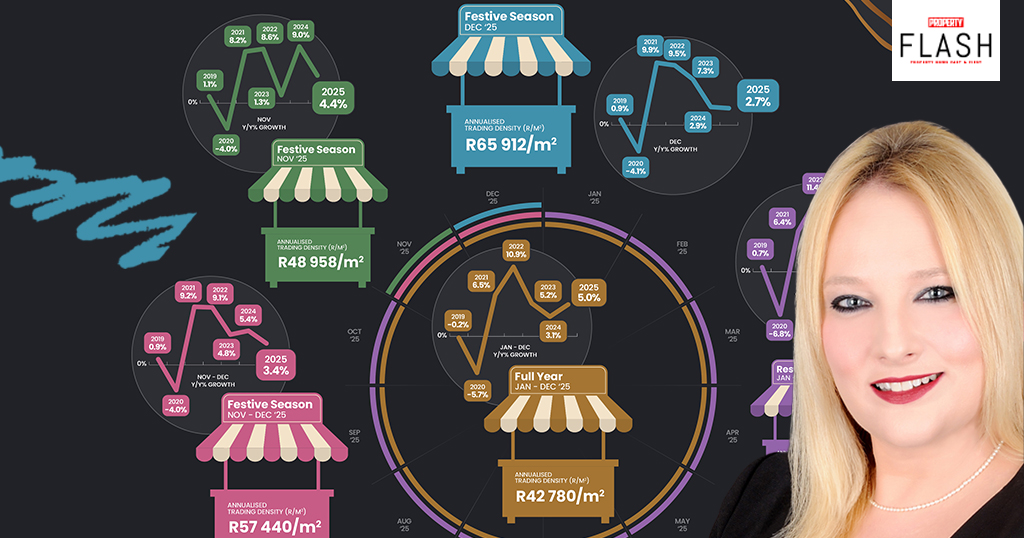
The November 2025 National Clur Index for All Centres closed with annualised trading density year-on-year percentage growth of 4.4%, under-performing the full year Clur Index by -0.6% and out-performing Nov 2025 consumer price inflation by 0.9%. Highest year-on-year percentage growth was shown by super-regional centres at 6.2%, and regional centres at 4.0%. The December index had annualised trading density year-on-year percentage growth at 2.7%, underperforming the full year Clur Index by -2.2% and under-performing Dec 2025 consumer price inflation by -0.9%. Highest year-on-year percentage growth was shown by community and smaller centres at 4.1%, and small regional centres at 3.5%.
“What was also significant was that Gauteng, the most populous province, was the top November performer in trading density growth of the three key provinces, outdoing the Western Cape and KwaZulu Natal. The Western Cape tends to occupy top spot, but for November it trailed Gauteng,” Clur says.
Gauteng had year-on-year percentage annualised trading density growth of 5.3% for November, followed by the Western Cape at 4.9%, and KwaZulu Natal at 3.5%. For the combined November and December season the Western Cape was the top performer, with year-on-year percentage annualised trading density growth of 4.0%. Gauteng had the second highest year-on-year growth rate of 3.8%. KwaZulu- Natal showed positive year-on-year growth of 2.7%.
For the full year the Western Cape had year-on-year percentage annualised trading density growth of 5.7%, outperforming 2025’s consumer price inflation by 2.5%. Gauteng was next with growth of 5.2%. KwaZulu-Natal had positive y/y growth of 3.6%, showing the highest growth expansion of 1.6% relative to June 2025.
This meant annualised trading density in the Western Cape of R49,682/sqm, in KwaZulu-Natal of 44,858/sqm and in Gauteng of R41,214/sqm for the full 2025 year.
For November and December combined, the Western Cape’s annualised trading density was R66,072/sqm, with KwaZulu-Natal at R62,067/sqm and Gauteng at R54,926/sqm. For November, the Western Cape had an annualised trading density of R56,370/sqm, with KwaZulu-Natal at R50,909/sqm and Gauteng at R47,823/sqm. The December results showed the Western Cape at R75,633/sqm, KwaZulu-Natal at R73,329/sqm, and Gauteng at R62,040/sqm.
The November and December combined national Clur Index for All Centres closed with annualised trading density year-on-year percentage growth of 3.4%, under-performing the full year Clur Index by -1.6% and contracting by -2.0% relative to 2024. The highest year-on-year percentage growth was shown by super-regional centres at 4.2%, followed by community and smaller centres at 3.6%. For the rest of the year (January to October) the index for all centres had annualised trading density year-on-year percentage growth at 5.5%, outperforming the full year Clur Index by 0.5% and expanding by 3.0% relative to 2024. Highest year-on-year percentage growth was achieved by community and smaller centres at 6.2%, followed by regional centres at 6.1%.
The full 2025 national Clur Index for All Centres showed annualised trading density year-on-year percentage growth of 5.0%, outperforming 2025’s CPI by 1.8%. Highest year-on-year percentage growth was by community and smaller centres at 5.5%, followed by regional centres at 5.3%. Super-regional centres had the highest expansion in growth versus Jun 2025 of 1.0%, followed by regional centres at 0.3%. Only community and smaller centres contracted by -0.1% against Jun 2025, with the All Centres Index expanding by 0.4% for the same period.
Clur says the two size extremes of super-regional centres and community and smaller centres continue to lead trading density volume levels.
For the full 2025 all centres index, annualised trading density for the year was R42,780/sqm, led by super-regional centres at R52,524/sqm, and community and smaller centres at R48,441/sqm. For the combined festive season all centres index, annualised trading density was R57,440/sqm, with super-regional centres on top with R74,041/sqm, followed by community and smaller centres at R60,298/sqm.
For the full 2025 year, the Western Cape had an annualised trading density of R49,682/sqm, KwaZulu Natal was next at R44,858/sqm, and Gauteng at R41,214/sqm.
On the rental front, Clur says the full year 2025 national Clur Index for the Base Rent to Sales ratio closed at 6.6%, indicating the ongoing entrenchment of stable and controlled market risk since mid-2024.
The Dec 2025 national Clur Index for Base Rent for All Centres showed year-on-year percentage growth of 5.4%, outperforming Dec 2025’s CPI by 1.8%. Highest year-on-year percentage growth was shown by small regional centres at 5.7%, followed by super-regional centres at 5.4%. The Western Cape led the three key provinces, with year-on-year percentage base rental growth of 6.7%, outperforming 2025’s consumer price inflation by 3.1%. KwaZulu Natal had the second highest year-on-year growth rate of 5.2%. Gauteng showed positive year-on-year growth of 4.9%.
In rand terms, the national index closed at a level of R245.28/sqm. Highest rentals were shown by super-regional centres, at R330.74/sqm, and regional centres at R240.09/sqm. The Western Cape had a base rental level of R271.36/sqm, with KwaZulu Natal at R253.54/sqm. Gauteng came in at R244.15/sqm.
Clur says that against the backdrop of pressure on consumers, and the retail drop-off, the Belief Economy, which was underpinned by a shift away from the often-superficial Attention Economy, has evolved.
“It is now signalling a new consumer connection point. Rawness, grit and creativity are new core values that resonate with consumers, seemingly in rebellion against overly polished, characterless and easily mass-produced AI outputs,” says Clur.
“These values, as a combined consumer culture concept, reflect in people rejecting slick perfection and being drawn to tactile unfiltered, more natural imperfect experiences that are less staged. They also relate to showing things as they are, without layering, supporting honesty, character and emotional clarity. Consumers want sensory engagement and provocation through texture, art, appealing visuals, engaging experiences and meaningful community activities,” she says.
Clur says this is evidenced in growing consumer tastes for minimally processed, natural food products as well as a preference for distressed fabrics, unfinished materials and visible craftsmanship in design and fashion.
“The rise of unfiltered social media content and candid media scenes further supports this, along with a wellness and lifestyle emphasis on raw emotions, self-expression, mental health, digital detox and a shift to ongoing body maintenance over performance,” she says.
“Strongly linked to this is the need to protect one’s unique voice and perspective, as well as personal re-invention. This is evidenced through increased emphasis on storytelling, adult learners and travel interest,” Clur says.

alistair@propertyflash.co.za
Partner content for Clur International
