
October 6 2026 11:05
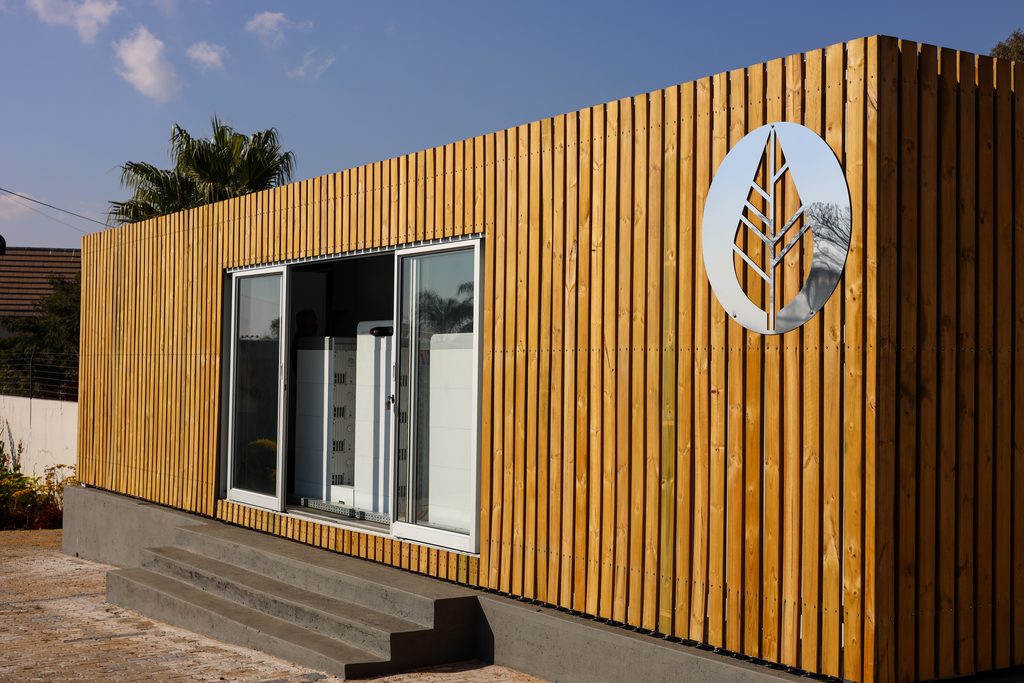
A Blockpower battery centre
Often described simply as a solar and battery company, Blockpower has repositioned itself as something closer to a private energy utility for community schemes. It has a flagship offering, branded Energy as a Service (EaaS), noting that for South Africa’s sectional title schemes the electricity problem has not gone away. Tariffs keep climbing, unplanned outages remain common in many metros, and trustees are left juggling levy shortfalls and prepaid-meter admin. Johannesburg-based Blockpower can fund, install, own, insure and run a scheme’s solar panels, batteries, smart meters and geyser controllers and, unusually, take over the scheme’s municipal electricity bill.
From one project to 300 systems
Blockpower started in 2016 with a single project. It now says it has deployed more than 300 systems across the country, adding up to over 34 MWh of battery storage and more than 13 MWp of solar capacity. Managing director Kyle Bohnsack has led that growth, and the company has stressed that its systems were developed locally for South African grid conditions.
Sectional title has been its core market from early on. In 2023 the company equipped The Emerald, a residential development in Hyde Park, Johannesburg, with solar and lithium-ion storage that removed the need for diesel generators altogether. Bohnsack said at the time that Blockpower always runs an energy audit before designing anything, and framed the systems as a hedge against rising utility and diesel costs.
Its clients now include body corporates, farms, lodges and business parks. The firm is a South African Photovoltaic Industry Association member, has worked on several EDGE-certified and net-zero developments, and partners with Johannesburg electrical contractor Electron Technologies on larger industrial projects.
How Energy as a Service works
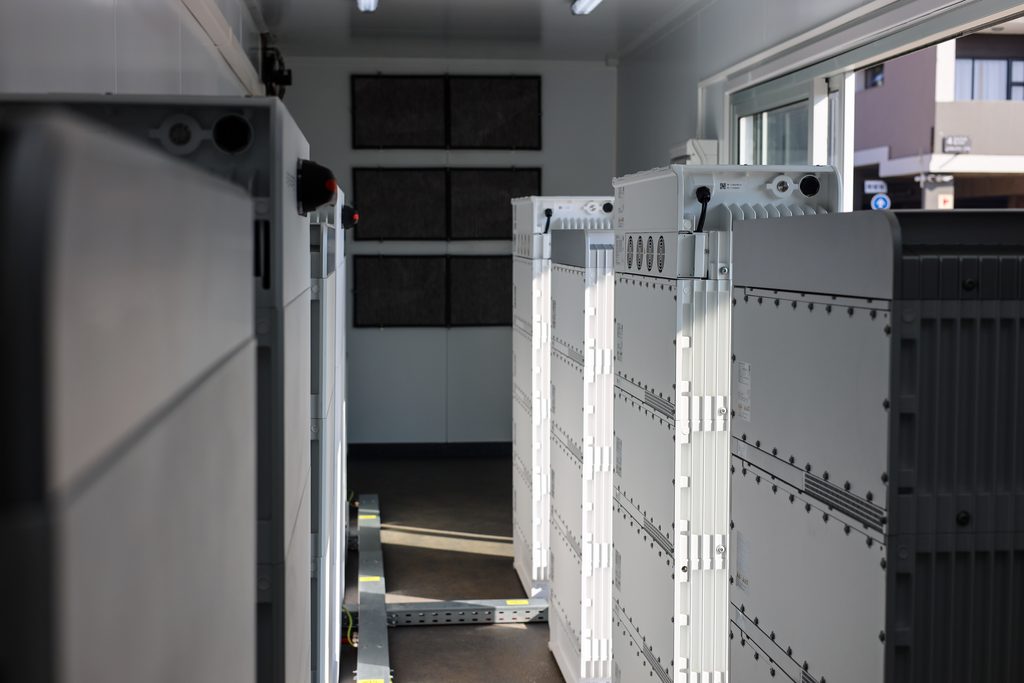
Inside the battery storage room
The process runs in five steps. Blockpower first assesses the scheme’s electricity account, usage profile, prepaid structure and financial goals. It then designs a managed service and a financial structure to match. Next it pays for and installs the solar PV, batteries, meters and geyser controllers, and insures every asset from day one. Residents carry on buying prepaid electricity exactly as before, while Blockpower settles the municipal account behind the scenes. Finally, the company monitors and maintains the system for the life of the agreement.
The economics rest on a simple premise: solar power produced on site is cheaper than grid power. That margin is what pays for the equipment, the insurance and the maintenance, while still allowing residents to be charged a tariff equal to or lower than what they currently pay. The body corporate puts up no capital, owns nothing and carries no insurance liability for the energy assets.
Three ways to take the benefit
Schemes can choose how the savings flow back to them. The first option is cheaper electricity for residents, with savings of up to 30% where NERSA-approved reseller rates apply. The second, which Blockpower says is the most popular, compresses future savings into an upfront cash injection that a scheme can use for maintenance, repairs or reserves without raising a special levy. The third is a fixed monthly income stream that can be used to hold down levies. Exact figures are set out in a term sheet after the assessment.
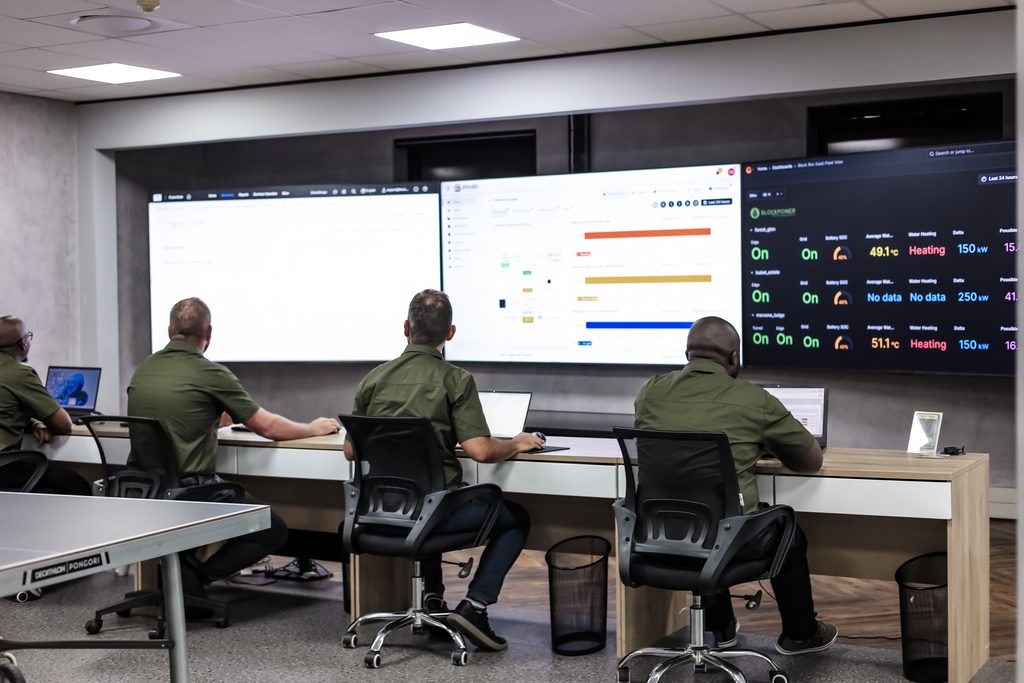
The control room
Not a conventional solar PPA
Blockpower is careful to distinguish EaaS from the solar power purchase agreements (PPAs) that have become common in the sector. Under a typical PPA, a provider sells solar electricity to the body corporate, but the scheme still pays the municipality for the rest of its power and often signs up for 10 to 25 years with escalations linked to inflation or higher.
EaaS, by contrast, starts with a three-year initial term with buy-out options, ties tariffs to municipal rates or below, and moves the municipal account, its admin and its exposure to tariff hikes onto Blockpower’s books.
Backup when the grid fails
The systems are hybrids that combine solar, batteries and the grid. Blockpower’s marketing quotes backup of between six and 12 hours, depending on system design and how much power the scheme is drawing at the time. During the day the panels recharge the batteries and heat geysers. When battery levels run low, residents are notified and the remaining capacity is prioritised for common-area essentials such as security systems, gates and lighting.
The 75% vote
Because EaaS commits the whole scheme to a long-term agreement over common property, trustees cannot sign it on their own. It needs a special resolution under the Sectional Titles Schemes Management Act, meaning 75% of members voting at a general meeting. Blockpower supports schemes through the voting process, but sectional title attorneys advise getting independent legal advice before approving any installation on common property.
Questions trustees should ask
Any scheme weighing the offer would do well to pin down a few things before the vote: exactly how the resident tariff is set and adjusted over time; what happens at the end of the three-year term and how the buy-out price is calculated; who is responsible for roof or structural damage linked to the installation; how backup capacity is allocated between units and common areas; and what remedies the scheme has if performance falls short.
Next: finance and water
Blockpower is now extending the same model beyond electricity. BlockFin, a dedicated funding arm for community schemes that struggle to access traditional finance, and Blockwater, a water-as-a-service offer built on the same invest-insure-maintain approach, are both due to launch by the end of 2026.
Why it matters for property
For owners and investors, energy resilience is no longer a nice-to-have. Backup power and lower running costs increasingly feature in how complexes are marketed to buyers and tenants, and a scheme that can fund repairs without a special levy is in a stronger financial position. Blockpower’s pitch is that a body corporate can get all of that without spending a cent upfront. Whether the numbers work out will vary from scheme to scheme, but the model is a notable shift in how South Africa’s five-million or so sectional title residents are serviced.
alistair@propertyflash.co.za
