
October 6 2026 18:20

Horizon Aparthotel, Sea Point, Cape Town
JSE-listed Heriot REIT has added a beachfront hotel to its growing Cape Town hospitality portfolio, converting an 11-storey residential block at 289 Beach Road in Sea Point into Horizon Aparthotel, a 36-unit boutique property operated by seasoned group Totalstay.
Horizon opened its doors on 1 May 2026, roughly 18 months after Heriot bought the building in late 2024. It is the real estate investment trust’s fourth aparthotel, and it arrives at a moment when Cape Town’s tourism numbers are setting records and the city’s hotel market is commanding some of the highest room rates in the country.
The timing has already shown up in Heriot’s numbers. In its results for the year to 30 June 2026, released last week, Heriot named the opening of Horizon as one of three factors that pushed second-half growth above first-half growth. Management has written a full year of trading at Horizon into its guidance of 14% to 18% dividend per share (DPS) growth for the 2027 financial year.
For a REIT best known for township and rural shopping centres anchored by Shoprite and Checkers, a boutique hotel on one of South Africa’s most expensive stretches of coastline may look like an odd fit. It is not. It is the latest example of a strategy Heriot has quietly been running in Cape Town for years: buying tired, well-located buildings and converting them into apartment-style hotels.
What has been built
Horizon is not a new-build. Heriot took an existing apartment block on Sea Point’s beachfront and fully converted it into hospitality use, rather than demolishing and starting again.
The completed property offers:
- 36 units across 11 storeys, made up of one- and two-bedroom apartments
- Four two-bedroom penthouses on the upper floors
- Open-plan kitchenettes and living areas in every unit, with en-suite bathrooms off each bedroom
- Flexible configurations, with several one-bedroom units able to be combined into additional two-bedroom units for families and groups
- A restaurant, a pool deck and rooftop facilities, with views across the Atlantic Ocean, Lion’s Head and Signal Hill
- Direct access to the Sea Point promenade, within walking distance of the suburb’s restaurants, shops and leisure attractions
Industry publication Tourism Update described the property as adding to Cape Town’s supply of mid- to upper-tier apartment-style accommodation, which is a fair summary of where it sits in the market. This is not a five-star resort, nor is it a budget short-let. It is aimed squarely at the traveller who wants a hotel’s service with an apartment’s space.
A repositioning, not a hotel development
Grant Elliott, chief operating officer of Heriot’s Western Cape portfolio, has been clear that Horizon was conceived as a repositioning exercise rather than a conventional hotel project.
Speaking ahead of the opening earlier this year, Elliott said the aim was to recognise the value of an existing, well-located building and repurpose it for a different kind of accommodation, one where guests get hotel-style flexibility together with self-catering facilities regardless of how long they stay.
“We approached the redevelopment with the aparthotel market front of mind,” he said. “Horizon is perfectly positioned on the Western end of Beach road (no 289) a stone’s throw to the Sea Point Pavillion and public swimming pools,” he said.
That approach matters for the economics. Converting an existing structure on Beach Road avoids the long and often contested rezoning and building-plan processes that new high-rises on the Atlantic Seaboard routinely face, and it gets a revenue-earning asset to market far faster. Heriot bought the block in late 2024 and was trading it as a hotel by May 2026.
Elliott also framed Horizon as part of a broader shift in the type of accommodation emerging in urban areas, with spaces designed to let guests work, live and relax in one place.
At the official launch, a rooftop cocktail event held in June for tourism, hospitality and media stakeholders, Elliott described the project as the culmination of an ambitious redevelopment that began with a vision to unlock the potential of an existing asset.
Totalstay’s bet on longer stays
Day-to-day operations sit with Totalstay, one of South Africa’s larger specialist aparthotel operators, with properties across Cape Town, Johannesburg and Pretoria.
Totalstay CEO Rael Phillips has argued that Horizon reflects a structural change in how people travel. He told Tourism Update that the group is seeing sustained demand across its portfolio for accommodation that lets guests stay longer and settle in more comfortably.
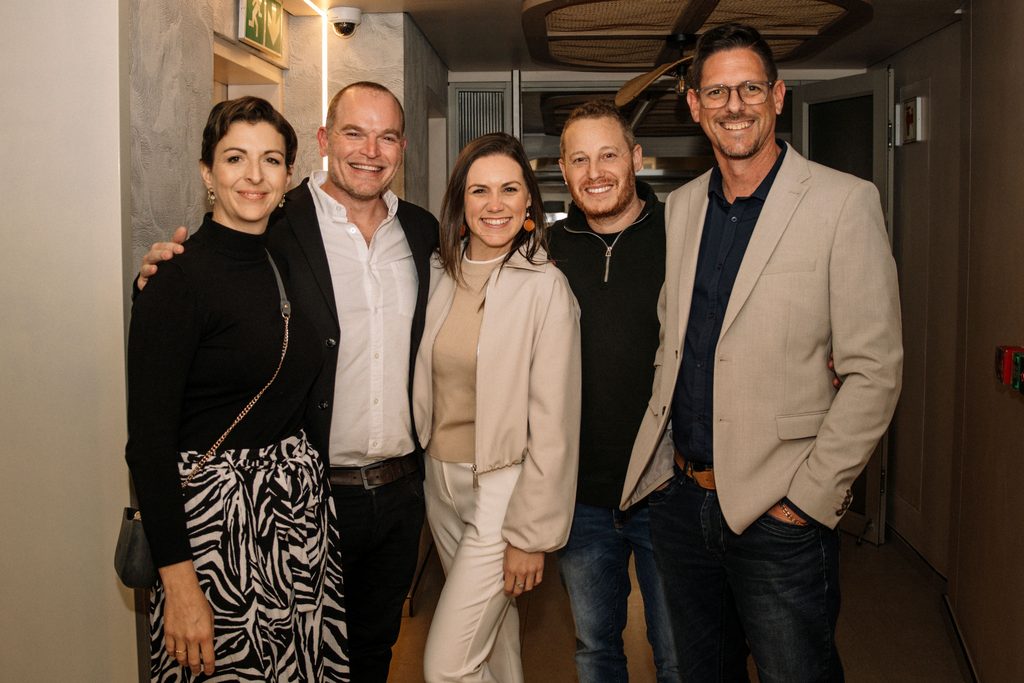
Gaby van Wyk, Rael Phillips, Siobhian Lockhart, Justin Asher and Grant Elliott and the Horizon launch
According to Phillips, that demand comes from three groups in particular: remote workers, international visitors on extended trips, and domestic travellers who blend business with leisure. Horizon, he said, was designed to give those guests a balance of flexibility and service.
At the June launch, Phillips spoke about the idea of bringing home rituals into a hotel setting, from a quiet morning coffee overlooking the ocean to finding a comfortable spot to work.
Totalstay’s own pipeline suggests the operator is confident the model travels. Last month, Property Flash reported that residential developer Tricolt Group had appointed Totalstay as aparthotel operator at The Madison in Cape Town and Olympus in Sandton.
Cape Town Tourism CEO Enver Duminy also welcomed the opening, calling Horizon a welcome addition to the neighbourhood’s hospitality scene and saying the launch reflected growing investor and operator confidence in the city as a world-class destination.
Why Heriot is in the hotel game
To understand Horizon, it helps to understand Heriot.
Founded by developer Steven Herring in 1998 and listed in 2017, Heriot has become one of the best-performing REITs on the JSE, even if it remains relatively unknown outside the property industry. The Herring family and management own much of the stock, which trades thinly, and the group develops, owns and manages its own assets.
The bulk of its income comes from retail. Shopping centres generated 74.4% of group net operating income (NOI) in the 2026 financial year, through malls such as Denlyn in Mamelodi, Atlyn in Atteridgeville, Thabong in Sebokeng and Birch Acres in Tembisa. In December 2025 Heriot completed its buyout of Safari Investments, paying R8.00 per share against a Safari net asset value (NAV) of R12.07, a deal that booked a R418.1m bargain gain.
But Heriot has also built a small, fast-growing hospitality niche in Cape Town by converting old residential and office buildings into aparthotels. The best known is One Thibault on Long Street, the former BP Centre, which was once the tallest building in the Mother City.
That niche is now pulling its weight. In the year to 30 June 2026:
- Aparthotel revenue rose 33.8% to R147.1m
- Aparthotel occupancy climbed from 55.6% to 69.5%
- Horizon contributed only around two months of trading to that result, having opened on 1 May
The segment is still small next to Heriot’s R14.0bn portfolio, but the growth rate is well ahead of the 8.5% like-for-like NOI growth delivered by its retail centres. Earlier results had already flagged that the aparthotel segment improved as new developments came online, properties were upgraded and management was outsourced to specialist hotel operators. Horizon ticks all three boxes.
A record year, with Horizon in the mix
Heriot’s results for the 2026 financial year were its third record in a row:
- DPS grew 16.7% to 142.29 cents, at the top end of its 14% to 17% guidance
- Distributable earnings rose 17.8% to R458.5m
- NAV per share climbed 17.1% to R24.11
- The portfolio, now 53 properties, was valued at R14.0bn, up 9.4%
- Portfolio vacancy was just 1.9%, with rent collections at 99.8% of billings
The final dividend of 76.18 cents per share is payable on 26 October 2026.
Te second half of the year grew faster than the first. The interim distribution was up 16.3%, and management attributed the stronger second half to full ownership of Safari, the opening of Horizon and a distribution from the newly acquired Katleho office portfolio.
Looking ahead, Heriot has three earnings drivers it describes as locked in for the 2027 financial year: a full 12 months of Safari at 100%, the consolidation of Katleho from 1 July 2026, and a full year of trading at Horizon. Against that backdrop, management is guiding for DPS growth of 14% to 18%, a forecast that already assumes two further 25 basis point interest rate hikes.
Sea Point and the Cape Town tourism boom
Heriot is not converting apartments into hotel rooms on a whim. The demand side of the equation in Cape Town has rarely looked stronger.
According to Cape Town Tourism’s Economic Value of Tourism report, the city welcomed 1.44-million foreign overnight visitors in 2025, who stayed an average of 9.5 nights. Hotel occupancy averaged 61.7% for the year and peaked at 81.5% in February, with an average room rate of R2,574. Cape Town International Airport handled 3.3 million two-way international passengers, up 7% year on year, with the UK, US and Germany the largest source markets.
The momentum has carried into 2026. South Africa recorded 1,005,286 international tourist arrivals in August alone, and more than 7.58-million between January and August. UN Tourism has named South Africa the strongest-performing African destination in the first half of 2026, with international arrivals up 12% on the same period last year.
That average stay of 9.5 nights is the key number for an aparthotel operator. Guests staying more than a week are exactly the people who value a kitchenette, a living area and a second bedroom over a standard hotel room, and it is the length-of-stay profile Totalstay says it is designing for.
Sea Point is one of Cape Town’s most densely developed and sought-after residential suburbs, with a promenade that draws runners, families and tourists year round. Hotel and short-let supply along Beach Road is limited by the simple fact that the strip is already built up, which makes conversions of existing buildings one of the few practical routes to new hotel rooms.
The risks
Horizon is not without its challenges, and neither is the wider aparthotel model.
Short-let competition. Sea Point is one of the most Airbnb-heavy suburbs in South Africa. Hotel industry body FEDHASA has noted that some formal accommodation providers have not seen growth in line with the sharp rise in tourist arrivals, as a growing share of visitors choose private rentals. Aparthotels compete head-on with that market, and must justify a premium through service, consistency and facilities. Horizon can do just that.
Seasonality. Cape Town’s tourism calendar remains skewed towards the summer months. Occupancy that peaks above 80% in February can fall sharply in the winter, and aparthotels need corporate and longer-stay guests to fill the trough.
Interest rates. All of Heriot’s debt is floating and unhedged. Each 25 basis point rate increase costs the group about R16.5m a year, or 5.1 cents of DPS, and the Reserve Bank has already raised rates twice since May 2026. Loan-to-value rose to 41.95% after the Safari buyout. Nevertheless, the company has managed its financial position well.
Concentration. Heriot’s hospitality assets are clustered in Cape Town, which makes the segment sensitive to anything that dents the city’s appeal, from air capacity to safety perceptions to infrastructure. The investment in Cape Town is unrelenting, however, and the government is on board to help to fast track development.
What it means for the market
Horizon is a small project in rand terms, but it is a useful marker for where Cape Town property is heading. First, it shows that listed landlords are increasingly willing to treat hospitality as an operational real estate play rather than leaving it to hotel groups. By owning the building and outsourcing operations to a specialist like Totalstay, Heriot captures the upside of strong tourism without having to build a hotel management business of its own.
Second, it is part of a broader wave of adaptive reuse in the city. From One Thibault on Long Street to Horizon on Beach Road, older buildings that no longer suit their original purpose are being reworked for a tourism economy that is growing faster than new supply can be built.
Third, it underlines how the line between residential and hotel property on the Atlantic Seaboard is blurring. Apartments are being built to be rented by the night, and hotels are being designed to feel like apartments. Horizon sits right on that line.
Horizon is exactly the kind of deal that has built Heriot’s track record: an existing asset, bought in a strong location, reworked for a market with clear demand and handed to a specialist operator. With a full year of Horizon trading now built into the real estate investment trust’s 2027 financial year guidance, the first proper test of the Sea Point bet will come when the results for the summer season are in. The signs of success are good!
This is not intended to be financial advice.
Partner content for Heriot Reit
