
November 5 2026 17:15
This is a guest article by Will Harris, CEO of Gmaven

Prime Sandton offices are changing hands for less than it costs to build a suburban house. The market has put a price on broken local government, and an election in November could hand Johannesburg’s property owners a windfall for doing nothing.
Capitec has bought itself a new head office. The Discovery building on Fredman Drive in central Sandton, diagonally across from the Industrial Development Corporation, is 21,946 square metres of generously parked, A-grade office space, near the top of the industry’s quality scale. The bank paid R245m for it, which works out at R11,164 per square metre, parking bays included.
To see how strange that number is, consider what ordinary building work costs. A family house in Johannesburg, at a finish most readers would recognise, runs from R18,000 to R25,000 per square metre before the land, and excluding basement parking bays. One of South Africa’s largest banks has paid less per square metre for a prime Sandton tower than a homeowner pays a builder in the suburbs.
Nor is the deal an outlier. Across Johannesburg, well-designed, well-parked, A-grade offices are consistently selling for under R10,000 per square metre. Putting up the same building today would cost at least R28,000 per square metre, excluding the land, or the developable bulk as the industry calls it, though including the parking. In Cape Town the same product, usually with less parking, fetches around three times as much: in May 2026 Spear, a Cape-based property fund, bought 28,488 square metres of office space in Tyger Valley for R33,698 per square metre. An owner-occupier like Capitec would have paid a premium above that.
Everyone in commercial property knows Johannesburg is cheap. The interesting questions are by how much, and what it would take for the gap to close. Compare like with like across the two cities and the answer to the first is R196 billion. That is the discount buyers currently apply to commercial property in Johannesburg municipality. R196bn is roughly 10% of the value of all commercial property in South Africa, or roughly five times Growthpoint’s market capitalisation attributable to its South African owned properties. And this value uplift is sitting in a single municipality.
The answer to the second question may arrive in November.
How a boring asset class lost its footing
Commercial property is supposed to be dull: illiquid, stable, slow-moving. In Johannesburg it has been anything but. As service delivery deteriorated, staff semigrated and public transport frayed, businesses voted with their feet. Some folded, others relocated, and demand fell. Landlords cannot conjure tenants, so owners have watched, largely helplessly, as value drained away.
In Cape Town, meanwhile, commercial values have kept pace with inflation, helped by an unemployment rate almost half Johannesburg’s. Property owners there feel like geniuses. Whether they are geniuses, or simply better governed, is what the numbers below try to settle.
What counts as Johannesburg
Two definitions first. Commercial property is the property that business is run from: offices, industrial, retail (shops and shopping centres, gyms and dealerships), and a “specialist” category that takes in the likes of hospitals, hotels, education, storage and other assets. We have excluded, for this exercise, residential – ranging from houses to high-density, investment-grade blocks leased by a single landlord to multiple tenants. Codera has already done a fine job on house prices.
Second, the boundary, because the municipality is not the city as most people picture it. Johannesburg municipality takes in office nodes such as Sandton, Rosebank, Waterfall City and Melrose Arch, industrial nodes such as Strydompark, Linbro Park and Midrand, and iconic shopping centres such as Sandton City and Mall of Africa. Going clockwise, Johannesburg municipality stretches to areas on its border like Diepsloot, Longmeadow, City Deep, Orange Farm, Lenasia, Roodepoort and Lanseria. It excludes, again going clockwise, Samrand, Midstream, Clayville, Chloorkop, Germiston, Bedfordview, Meyersdal, Evaton and Krugersdorp. The city as commonly understood is actually two municipalities: Johannesburg plus Ekurhuleni, the East Rand, which is also home to OR Tambo International, the country’s major airport.
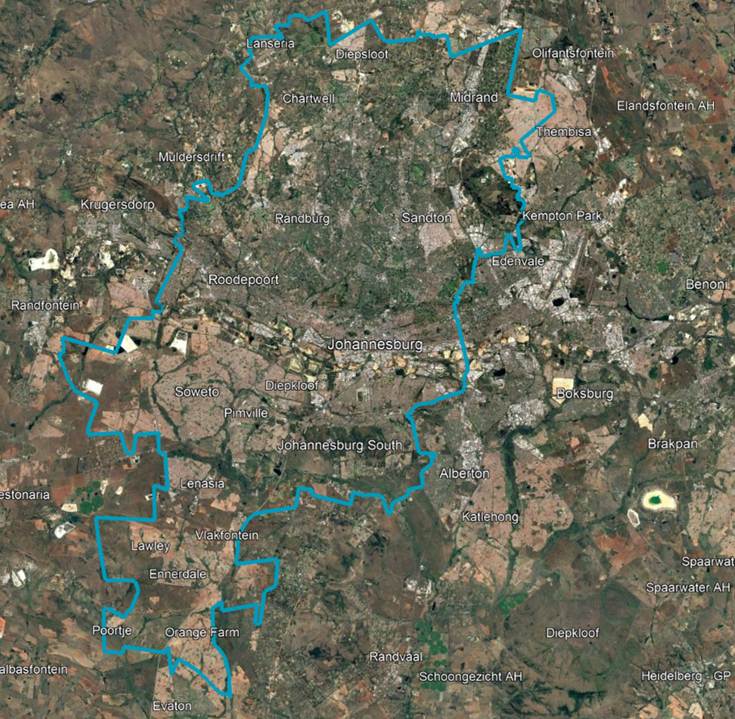
Johannesburg municipality’s boundary. The city as commonly understood also includes Ekurhuleni (the East Rand).
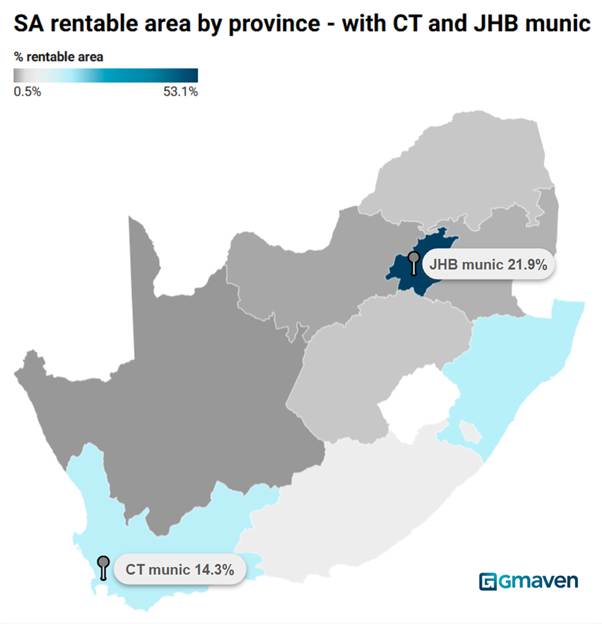
The stakes are national. South African commercial property is conservatively worth R2 trillion and covers 205 million square metres of rentable space. Johannesburg municipality alone accounts for 21.9% of the country’s gross lettable area, or GLA, the industry’s measure of rentable space. That is more than the whole of KwaZulu-Natal (16.3%) or the Western Cape (15.7%), and more than the six remaining provinces combined. Count the East Rand as well and the greater city holds 37.3% of all commercial space in the country.
Apples with apples
A study this size demands rigour, because commercial property punishes lazy comparisons. The analysis, drawn from the national commercial property database of Gmaven, a commercial property data company, covers 25,700 properties, matched on property grade, category and size, on comparable locations and, for retail, on sub markets and sub-categories, so that like is compared with like. The yardstick is market value: what a willing buyer actually pays, the truest determinant of value. Since 2020, 1,706 higher value commercial transactions worth a combined R83bn have passed through the deeds office, the registry where South African property transfers are recorded. Stripping out duplicates, related parties, and high-noise portfolio transactions leaves roughly 1,100 unique, high-signal deals.
Here is what those deals, averaged over this time period (which straddled the Covid pandemic), say a square metre is worth in each city.
| Weighted average value per square metre | Industrial | Office | Retail | Specialist |
| City of Cape Town | R7,552 | R20,524 | R19,752 | R17,079 |
| City of Johannesburg | R5,550 | R10,121 | R13,787 | R8,238 |
Cape Town has traded above Johannesburg in every category. Industrial, mostly in the hands of owner-occupiers, has largely held its value on both sides of the divide. Office is where the damage sits: Cape Town office space, averaged out, trades at more than double Johannesburg’s R10,121 per square metre (despite the latter being, generally, better parked). Retail in Johannesburg has felt pain too. Recent transactions, across the board, see the gap widening. And that, for anyone hunting value, is where the opportunity lies.
The two municipalities are also built differently, and not in the way you might guess. Cape Town is the industrial-heavy one: industrial makes up 47.9% of its rentable area, against 13.9% for office, 28.6% for retail and 9.5% for “specialist”. Johannesburg is far more evenly spread: 32.5% industrial, 25.2% office, 28.6% retail and 13.7% “specialist”. Part of the reason is that Johannesburg’s industrial heartland is not in Johannesburg at all, but next door in the East Rand: Ekurhuleni municipality has 168% of the industrial floor space of its neighbour to the west. The combined city boasts 51.2% industrial, and only 16.1% office.
Cape Town and Johannesburg municipalities: rentable space by property category.
Two cities on paper
Cape Town’s total commercial rentable area comes to 29.2 million square metres, which is 468,300 squash courts, 49,100 tennis courts or 3,200 rugby fields, depending on your sport. Johannesburg’s is 44.9 million. Apply the sales evidence since 2020 to those stocks and the market values come out at R365 billion for Cape Town and R376 billion for Johannesburg. Johannesburg has 54% more space, but the market says the two cities are worth roughly the same.
The municipalities’ own books tell a different story again. The latest annual financial statements value commercial property at R310.7 billion in Cape Town and R444.5 billion in Johannesburg (as at 1 July 2022 each). If municipal valuations are meant to track the market, Johannesburg’s owners can expect some rates reductions in 2027.
Then there is the cost of building it all again. Not all buildings cost the same to put up: industrial is the cheapest to build, retail costs more, and office is the most expensive, in every case excluding the land or developable bulk. Priced at AECOM’s construction rates, on conservative assumptions, a wholesale redevelopment would cost (including bulk) R537 billion in Cape Town and R857bn in Johannesburg. In Johannesburg, industrial has maintained its value, but buyers of retail and, above all, office have been buying close to just over a third the cost of construction.
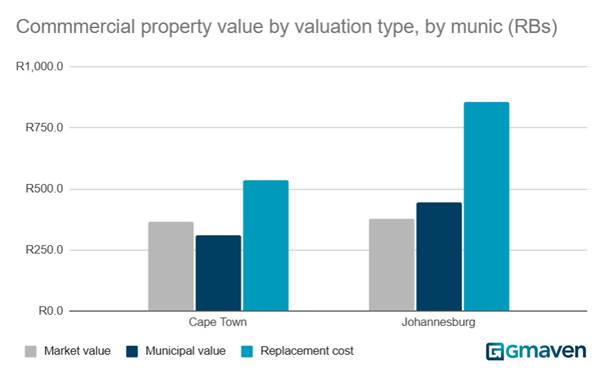
Commercial property values per municipality by specific valuation type
Where the R200 billion sits
Adjust for Cape Town’s historical price premium and the uplift available to Johannesburg, category by category, comes to R196bn. Office accounts for over 40% of it, followed by retail, then the ‘specialist’ category, then industrial.
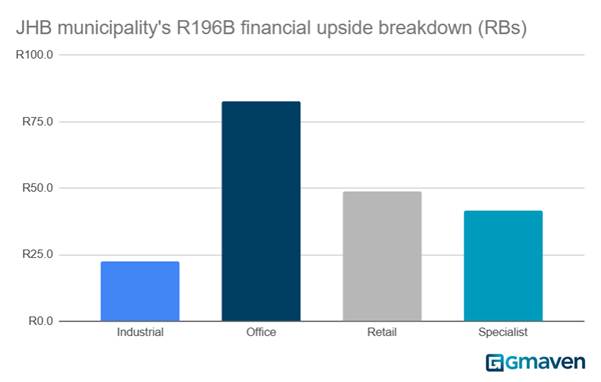
One variable
The conclusion is simple, and it is not about property people. Johannesburg’s discount says nothing about the quality of its property entrepreneurs and managers. It is not geography either: that is already priced in. What the market is pricing is one factor, the competence of local government, and it is the one factor that may change in November, when the city votes in local government elections. Cape Town, majority run by the Democratic Alliance for 15 years now, shows what the same asset class does under an administration that works.
If Johannesburg’s administration changes, and service delivery with it, the numbers above imply an enormous upswing in value and investment, to the benefit of investors, the employees of the property funds, construction firms and lenders alike. An improvement in South Africa’s economic growth will supercharge this. Johannesburg’s commercial property owners are overdue some luck. For once, they do not have to do anything to earn it. They just have to hope somebody fixes their city.
About Gmaven
Gmaven is a South African commercial property data and software provider. The analysis in this story is drawn from its national database of commercial properties and deeds office transfers: the two municipalities’ 25,700 matched properties and 1,090 unique, high-value transactions since 2020. [Media contact: William Harris, william@gmaven.com, 083 383 7365]
247@propertyflash.co.za
